Politically, Europe and the US have bifurcated. In word, image, thought and action, however, an energy continues to bounce back and forth, an energy that we can only hope undermines the rightward movement towards ultranationalism. “Europe” figures in many American discourses as either a point of origin to push back against, or a post-colonial skein to completely overcome. But the idea of the European Union is also now one of the best wedges against ultra-nationalism, especially as it allows for multiple languages and arts to thrive.
From April 11th to April 20th 2026 I was in Madrid, with a one day train trip during that period to Valencia. The immediate cause for the visit to Spain was the publication release of a book length poem of mine, IF (Talisman House, 20011) in Spanish translation.
Now under the title Cosmos Compensatorio, from Varasek Ediciones, the Spanish text and the English text are en face in the volume. The fact that Varasek has a long term commitment to The New American Poetry, having published in Spanish translation in the past Joanne Kyger, Michael Mclure, Gary Snyder, Lew Welch, Phillip Whalen, Jack Spicer and Charles Bernstein, among others, made it a special honor for my work and more modest profile.
The company of translated poets was great – and so were the people I met in Spain as well as from the outset of the adventure.
The book began with the Spanish writer Marta del Pozo, who did the translation ten years ago. She is a terrific poet, her recent book Nigredo having been highly esteemed long before it ever came out in Spain. Marta is also the publisher and editor of Quantum Prose, devoted to publishing Spanish language works in English as well as works that mingle the languages of poetry and science. Years ago she told me that she wanted a poetry in which experimental formalism does not shrink from existential substance, and that, flatteringly, she found these two elements in IF. This is what motivated her to translate the book, then find a publisher. For all these reasons the book is as much hers as mine. Also too at a certain point she realized that IF could not be the Spanish title, since “si” means “yes” as well as “if” in Spanish, which would blur the very commitment to the conditional and the hypothetical that “if” seeks to emphasize in the writing. She loved the translated phrase “cosmos compensatorio”, for “compensatory/cosmos” in the original. That became the new title. So the poem transforms and changes its framing in a new language.

Leonard Schwartz and Marta del Pozo
Del Pozo teaches Spanish at the U of Massachusetts and could not be in Spain in April. In Madrid, however, Ediciones Varasek publisher and editor Antonio Cordero Sanz took me under his wing, having arranged openings in bookstores in Madrid and Valencia, Enclave de Libros and La Libra, respectively. Antonio is a poet, the author of Zen Bombadier among other books and an inveterate world traveler, from the Amazon to North Africa to Indonesia, back-packing through these places as a younger person and arranging travel for others later on, even as he continues to explore borderlands and difficult places to reach, to this very day.
One can see the influence of the Beats on this Spanish intellectual in terms of the shared desire to get outside the box, to enter the wilderness.
It is also true that as early as his 1955 book Tristes Tropiques French anthropologist Claude Levi-Strauss wrote about going into the most remote and least contacted parts of the Amazon to mostly only find himself, and that Antonio is also too a great reader of Levi-Strauss. There is no naïve relationship to the outside here. One’s shadow is long. Is it possible that The New American Poetry can be understood within this paradigm of a desire for the outside and an awareness of one’s own reflection? Kerouac’s On the Road expresses the desire to break out but also the trap of one’s own desire. Spicer speaks directly of “the poetry of the outside”, some savage muse filling in the space of one’s voided personality. Whalen and Welch seek to slip the vise of the self on their road to Buddhism. Poetry is a path through language that is also a labyrinth, which may be to say it is a path that is not a path but a kind of being lost, whether in the misery of self-consciousness or the grandeur of the universe. The New American Poetry offers responses to both the dream of getting outside and the awareness of one’s own reflection or shadow, as play or prison.
Since Del Pozo could not be in Madrid, Cordero Sanz read the Spanish translations on the evening of April 14th, accompanied by Cuban poet Marcelo Morales. I had the opportunity to spend some time with Morales on two occasions, once preparing for the event over a beer, the other time simply over a beer. He is one year in Madrid, soulful, casting about in the city in search of his footing, after periods of time in the US and of course in Cuba. (Responding to the poster for the announcement of the reading poet Forrest Gander, also a celebrated translator from Spanish, wrote to me “Fantastic you are reading with the brilliant Marcello.”) Marcello Morales will find his way. People can see the spark. Varasek Ediciones has published his book too.
It is also true that I gained a brief glimpse into the Cuban émigré scene in the city, since Cuban painter Maikel Sotomayor attended the reading, as did writer, painter and “homeopathic humanist” Jorge Pablo Lima, Pablo even reading one of the sections of Cosmos Compensatorio out loud in his resonant baritone voice. I wish I could have learned more about this vibrant Cuban arts scene currently asserting itself in Madrid.
On my first night in Madrid, I had met for dinner with Spanish poet Jordi Doce, thanks to the suggestion of Argentine poet Mercedes Roffe and Spanish poet Marta Lopez-Luaces, both of whom are based in NYC. His book Master of Distances was published in English translation in the UK by Shearsman in 2023, translated by Terrence Dooley. The book does something unusual, placing the translation of each prose poem at the top of the page, the Spanish original on bottom, a configuration I have rarely seen. The poem takes us into the bleak but illuminated passage of terminal disease, a condition itself of course predicated on mortality itself:
This is no life. The watchful eye that questions everything.
The heraldic shriek of the owl. The raptor’s wing-shadow. Lets the
nights bury the nights. Asi no hay forma de vivir. El ojo vigilante que todo lo interroga.
El ulular heraldico de la Lechuza. Esa sombre de ala cazadora.
Dejemos que las noches entierren a las noches.
— Master of Distances, Page 28
Or again, and this time I only reproduce the translation:
Every step you take is a light that switches on, on the other side,
beneath the ground, beneath your shadow. A star distant, beyond reach.
You walk on a will o’ the wisp that steals your image and stops you
recognizing yourself, knowing who you are. Call it thirst, desire, an
avid vein. Call it blind-me, sleepless-me, cannibal.
— Master of Distances, Page 87
Jordi Doce not only did me the honor of attending the reading but of speaking about the work afterwards. Editor, translator, poet actively engaged between both British and American and Spanish poetry, Doce will I hope be read widely in the US in the years to come.
At dinner after the reading I met Spanish poet Marcos Canteli. Canteli is a translator of Robert Creeley, Jack Kerouac, Philip Whalen and others, a PHD from Duke University, and the director of Duke’s Study Abroad in Madrid program. We ended up talking quite a bit about the poet Joseph Donahue, a national treasure of American poetry hidden in plain sight at Duke, where the two of them met. Donahue’s body of work, and his ongoing poetic sequence Terra Lucida, is clearly a late great flowering in the poetic lineage under consideration above. I came away thinking that Marcos Canteli was a key link in the exchange, indeed the cross-pollination, between Spanish and American poetry. Later in the week I met a young poet in Madrid, a student of both Canteli’s and Donahue’s, Iranian-American Nima Babjani-Feremi, which confirmed for me what a vibrant scene Duke University and Marcos Canteli are themselves creating in Madrid.
In Valencia too, on Thursday, April 18th, on the occasion of the reading for Cosmos Compensatorio in that city, I met many interesting people. Antonio and I were joined in doing the reading by Antonio Méndez Rubio, a highly regarded Spanish poet, much beloved in Valencia. Beforehand we met for lunch, along with two Argentine poets, Arturo Borra and Laura Giordani, the latter a poet and professor and keeper of the poetry site, https://lauragiordani.blogspot.com/ Her book Micelio, steeped in the tropes of mycelium, looks intriguing, and allowed us to talk about mushrooms, the long cords of mycelial communication, and the largest organism on the planet, located in Oregon and mycelial in nature.
Back in Madrid, at the National Museum of Archeology, I encountered several works that moved me to the core. This is an unusual museum that lets you feel the texture of the archeologists work without ever lionizing them, as sometimes happens, and it contains a multitude of indigenous Iberian riches.
The Iberian Chalcolithic “idol of Extremadura” is an alabaster object that is equally abstraction and a pair of open eyes; as such we see through abstractions. One theory holds that its gaze and its features are patterned on an owl. But which owl? The object struck me full square and was not only an object but an energy. I had spent the past two years in proximity to an owl, for a book I collaborated on with German artist Heide Hatry, entitled Flacofolio. Flaco was the Eurasian eagle-owl that escaped the Central Park Zoo and lived freely in NYC for a little over a year, before his death; the story of the owl opened up for Hatry and I in multi-faceted ways, liberatory and tragic at once. Now the idol of Extremadura seemed to look at me directly, to speak of Levinas and his idea of the ethics of the face-to face encounter, as I had written of in Flacofolio, for example in “Self and Other”:
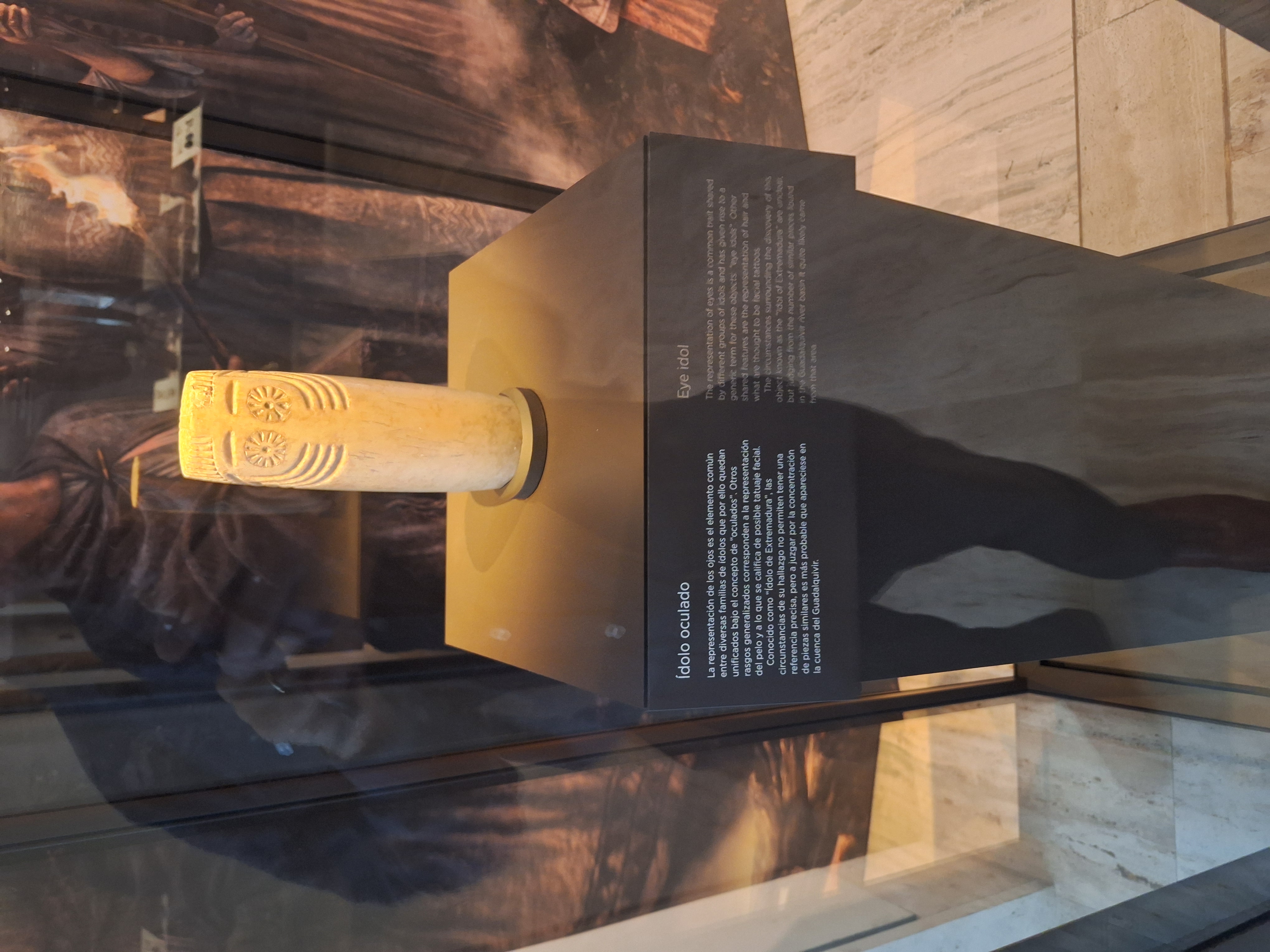
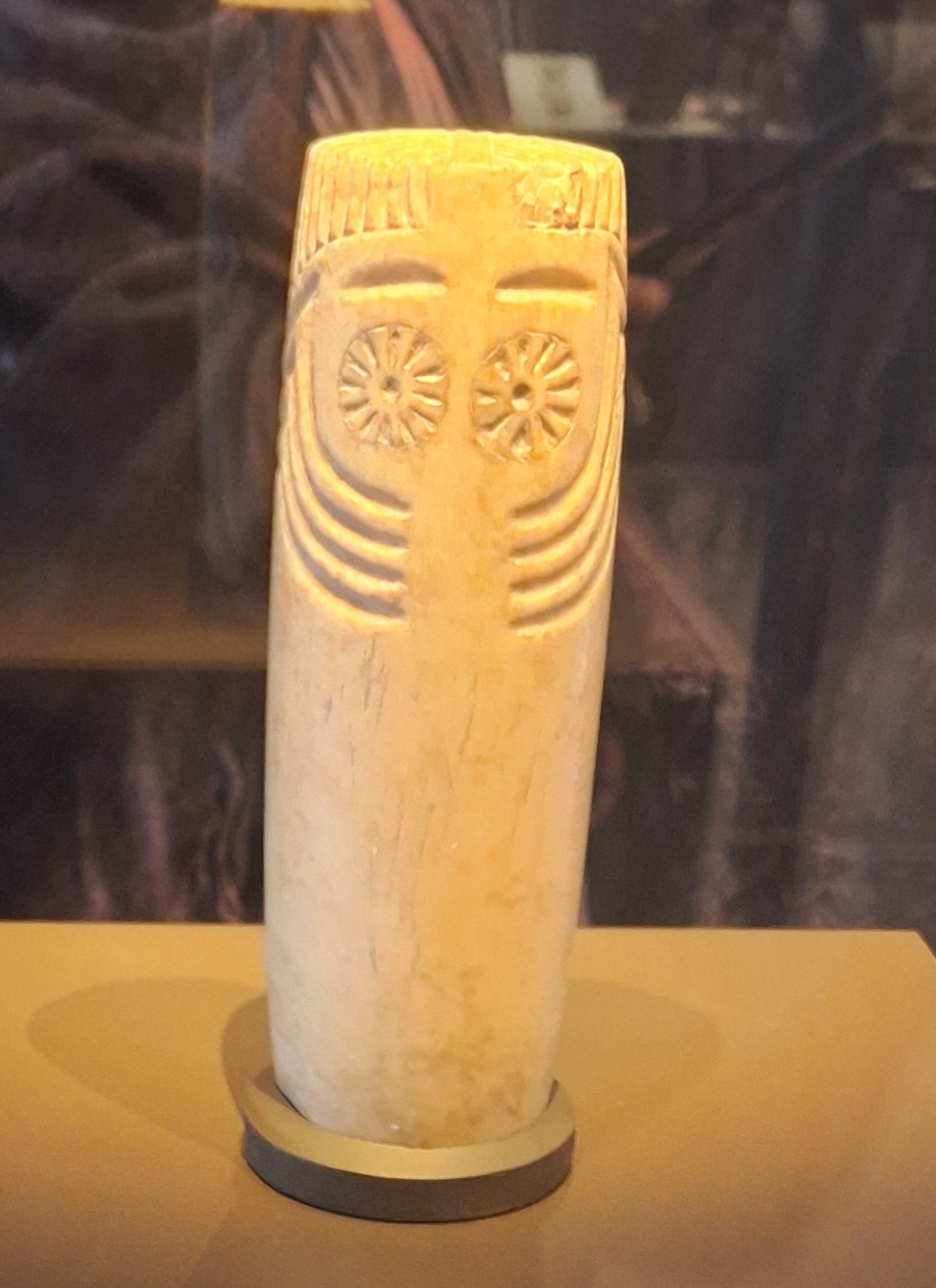
Idolo oculado (Eye Idol)
There are murals of Flaco spraypainted all over the city. On the Bowery
near Stanton on a wooden board that is part of a business’s façade is
a painting of Flaco’s head, only the head, bright red against a background
as yellow as his eyes, his eyes and beak central, black and white
tears that might also be feathers shedding to each side of his face.
Near Houston Street a giant multicolored Flaco towers over a rendering
of the city’s skyline, a blue snake slithering rightwards above the owl’s
head. Coming up from the subway on 2nd Avenue is a seemingly cross eyed
Flaco with “King Flaco RIP” spraypainted in black over a blue background
under the tuft of his left ear.
The testimonials are to eye contact. To I and You. To the expressivity
of the face without expression. To the expression not of the personality but the soul.
— Flacofolio, Spuyten Duyvil, 2025, Page 77
New to Madrid, with plenty of time to myself, I was often lost in the labyrinth of the city’s narrower streets, sometimes knuckling under and using my phone to find my way, eyes bent to the spoon-fed map in the little gadget in my hand. The Idol of Extremadura spoke to me about the need to look up and see, even if lost, especially if lost! Embodied in this object (the eye idol, not the iPhone) is the lure of the unknown, a pre-reflective awareness of the self as obstacle, the bright trace of animism, and the sense of humor necessary to cope with the uncertainties of becoming.
Note: A review of the original edition of IF can be found at Jacket 2 here:
https://jacket2.org/reviews/vagabond-imagination:
Photo Credits
1. Carlos David
2. Leonard Schwartz